
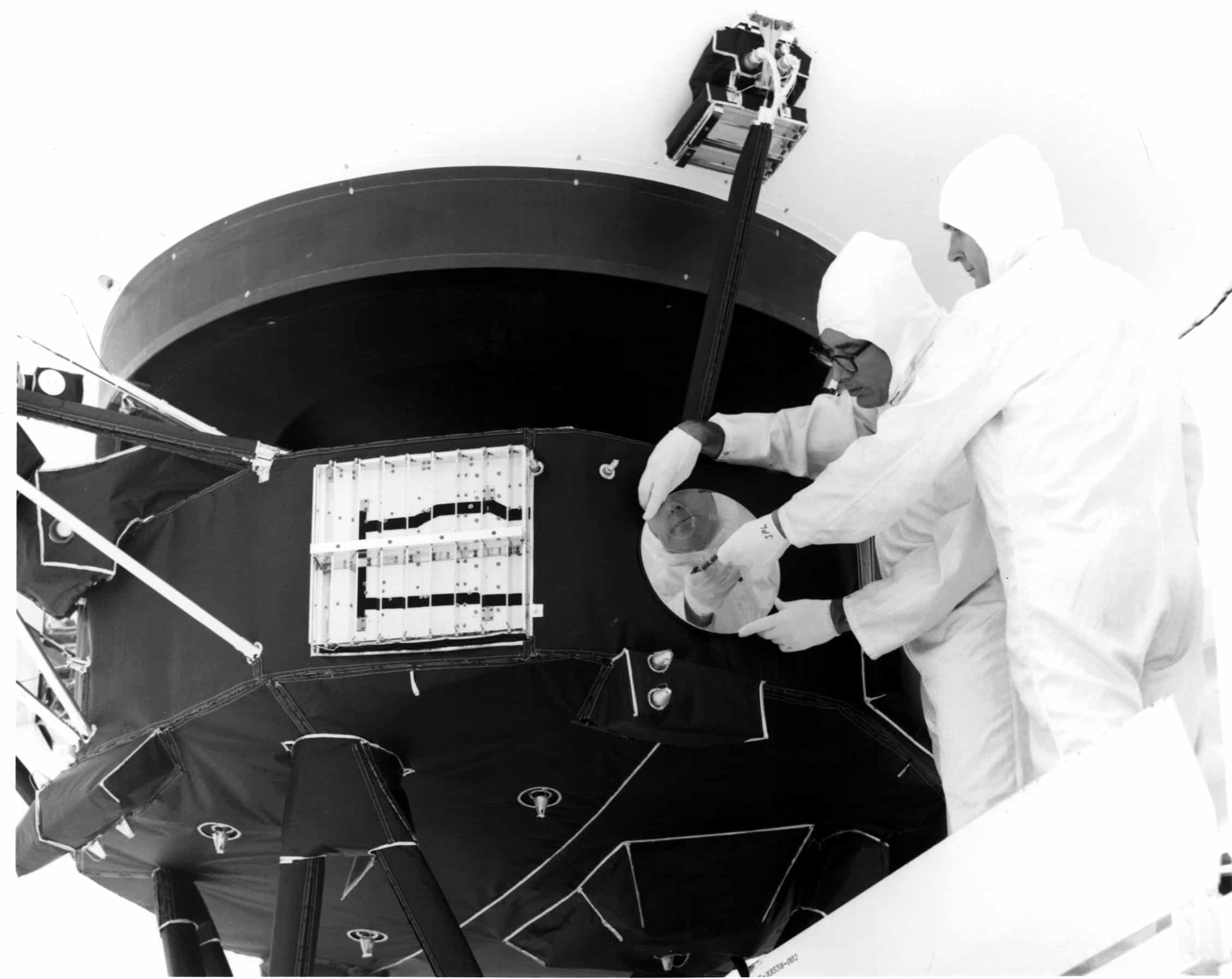
File photo: Technicians attach the Golden Record to Voyager 1 on July 29, 1977. Photo: NASA / Wikimedia Commons · Public domain (NASA).
Nearly half a century after launch, Voyager 1 has crossed a threshold no other spacecraft has reached. NASA confirmed that the probe became one light-day distant from Earth on November 18, 2026. At that distance, a radio signal needs roughly 24 hours to reach its destination.
What one light-day means
The milestone represents approximately 16.1 billion miles, or 25.9 billion kilometers. Voyager 1 was launched in 1977, explored Jupiter and Saturn and crossed into interstellar space in 2012. Its twin, Voyager 2, followed into interstellar space in 2018.
Communications are still a challenge
NASA’s Jet Propulsion Laboratory said on November 19 that Voyager 1 was transmitting a carrier signal even though engineers had not received science and engineering data since November 14. The team confirmed the distance milestone using that signal and calculations of the spacecraft’s trajectory.
A command from Earth and a return transmission now require about two days of travel time alone. Engineers are investigating the data problem while managing the aging probe’s limited power supply.
Why it matters
The mission illustrates the extraordinary durability of spacecraft engineering, as well as the limits of communicating across interstellar distances. Voyager 1’s journey continues to offer a rare opportunity to study the region beyond the Sun’s protective bubble.
Source: NASA Jet Propulsion Laboratory, November 19; NASA explanation of the light-day milestone.